Why Your Chihuahua Is Acting Aggressive (It’s Not What You Think)
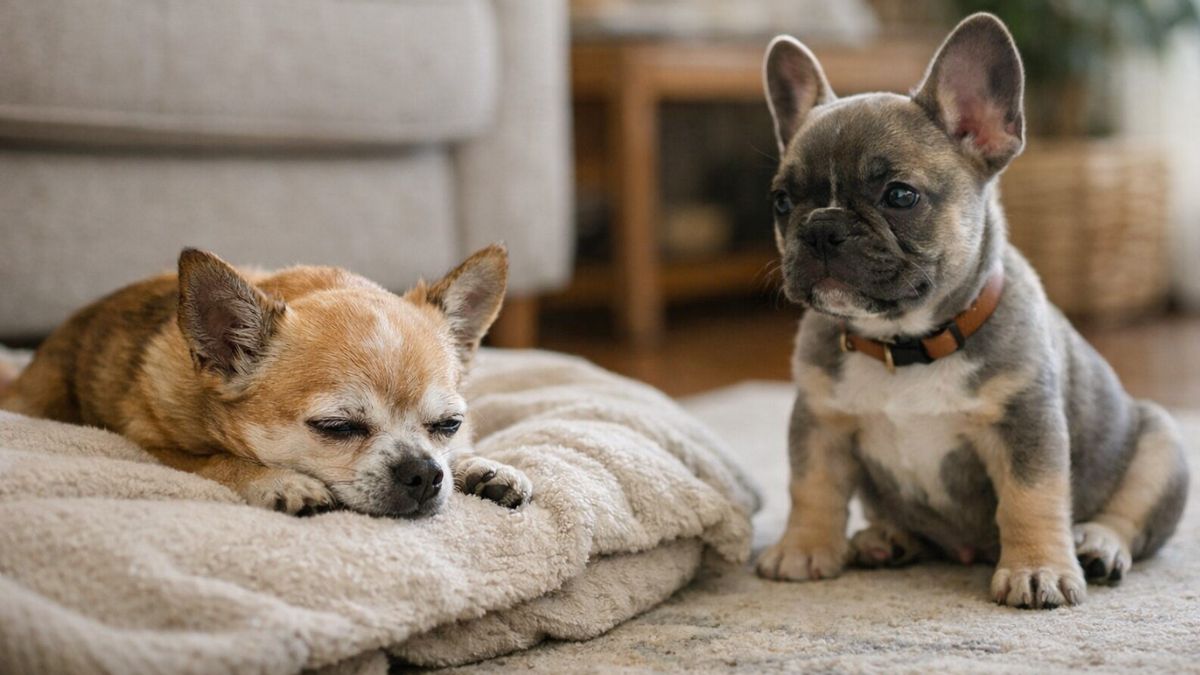
You brought home an adorable French Bulldog puppy. You expected joy. Instead, your 6-year-old Chihuahua turned into a barking, snapping nightmare.
Here’s what’s really happening:
Your Chihuahua isn’t being mean. He’s overwhelmed—and desperately trying to communicate one simple message:
“I need space. I don’t understand this chaotic creature. Please help me feel safe.”
This isn’t about dominance, jealousy, or “being the alpha.”
It’s about sensory overload and communication breakdown between two dogs who speak different languages.
Let me show you exactly how to fix this—starting today.
The Real Problem: Age Gap + Breed Differences
Why Chihuahuas and French Bulldogs Clash
| Chihuahua (Senior) | French Bulldog (Puppy) |
|---|---|
| Quiet, predictable routine | Loud, unpredictable energy |
| Needs personal space | Invades personal space constantly |
| Small, vulnerable body | Sturdy, bouncy, accidentally rough |
| Protective of resources | Doesn’t understand boundaries yet |
| Communicates with subtle signals | Ignores subtle signals completely |
The mismatch is biological—not behavioral.
Your Chihuahua is hardwired for vigilance. At 6-8 years old, he’s set in his ways. Routine = safety.
Your Frenchie puppy? He’s 3-4 months of pure chaos. He doesn’t mean harm—he just hasn’t learned dog manners yet.
What NOT to Do (Even Though Everyone Does This)
❌ The 3 Mistakes That Make Things Worse
-
Picking up your Chihuahua every time the puppy approaches
→ This teaches your Chihuahua: “Yes, the puppy IS dangerous. Keep barking.” -
Scolding the puppy more than the older dog
→ Creates resentment and confusion. The puppy doesn’t know WHY he’s wrong. -
Keeping them separated 24/7 “just in case”
→ They never learn to coexist. Fear increases with every failed introduction.
The uncomfortable truth?
Most owners accidentally reinforce the exact behavior they’re trying to stop.
7 Steps to Help Your Chihuahua Accept Your Frenchie Puppy
Step 1: Create a “Puppy-Free Zone” for Your Chihuahua (First 48 Hours)
Your older dog needs a safe haven where the puppy CANNOT enter.
Setup:
- Elevated bed or crate in a quiet room
- His favorite toys and blankets
- Water and food bowls (separate from puppy)
- Baby gate or closed door
Why it works:
Your Chihuahua can decompress WITHOUT constant puppy harassment. Stress hormones drop. Barking decreases naturally.
Step 2: Parallel Walking (Day 3-7)
Before they interact indoors, walk them together but apart.
How:
- Two handlers
- 6-10 feet distance between dogs
- Same direction, same pace
- NO eye contact between dogs
Duration: 15-20 minutes, twice daily
What you’ll notice:
- Day 3: Less reactivity
- Day 5: Curiosity instead of aggression
- Day 7: Relaxed body language
This technique is called parallel desensitization—and it’s backed by veterinary behaviorists worldwide.
Step 3: Scent Swapping (Day 4-10)
Dogs process the world through smell first.
Exercise:
- Rub a towel on your Chihuahua
- Place it in the puppy’s bed
- Do the same in reverse
Repeat: Daily for one week
Science behind it:
Familiar smells = reduced cortisol (stress hormone). Your Chihuahua starts associating the puppy’s scent with safety instead of threat.
Step 4: Controlled Visual Contact (Day 7-14)
Now they can see each other—but NOT touch.
Setup:
- Baby gate between rooms
- Both dogs on opposite sides
- Feed them at the same time (through the gate)
Duration: 10 minutes, 3x daily
Progressive steps:
- Day 7: Just looking
- Day 10: Eating near gate
- Day 14: Calm coexistence
If your Chihuahua barks, increase distance. Never force proximity.
Step 5: First Physical Introduction (Week 3)
Rules:
- Neutral space (not Chihuahua’s territory)
- Both dogs leashed
- Short session (5 minutes max)
- End on a positive note
Green flags:
✓ Loose body language
✓ Brief sniffing
✓ Natural disengagement
Red flags:
✗ Stiff posture
✗ Prolonged staring
✗ Growling without moving away
Pro tip: If your Chihuahua growls and WALKS AWAY, that’s actually good. He’s self-regulating instead of attacking.
Step 6: Enforce “Puppy Manners” Training
Your Frenchie needs to learn consent-based interaction.
Key commands:
- “Leave it” (when approaching the Chihuahua)
- “Place” (go to your bed)
- “Gentle” (calm approach)
Training schedule:
- 5-minute sessions
- 4x daily
- High-value treats for calm behavior near the Chihuahua
Reality check: Your puppy will NOT master this overnight. Expect 3-4 weeks of consistent training.
Step 7: Equal Treatment Protocol
This is the secret sauce most trainers won’t tell you.
The rule: Whatever you do for one dog, you do for the other—in EQUAL measure.
Examples:
- Pets? Same amount of strokes for both
- Treats? Same number, same timing
- Playtime? Rotate individual attention equally
- Tone of voice? Same warmth for both
Why this matters:
Dogs are INSANELY sensitive to favoritism. Even unintentional bias creates rivalry.
If you comfort your Chihuahua more, he learns: “I’m the victim. The puppy is the enemy.”
Timeline: What to Expect (Realistic Version)
| Week | Progress | What It Looks Like |
|---|---|---|
| 1 | Awareness | They acknowledge each other exist |
| 2 | Tolerance | Less barking, more ignoring |
| 3 | Coexistence | Can be in same room, different activities |
| 4-6 | Curiosity | Brief positive interactions |
| 8-12 | Acceptance | Relaxed cohabitation |
| 3-6 months | Friendship (maybe) | Play, sleep near each other |
Critical note: Not all dogs become best friends. Peaceful coexistence is success.
When to Call a Professional Behaviorist
Some situations need expert help:
🚨 Red alerts:
- Blood-drawing bites (not just air snaps)
- Attacks during sleep
- Resource guarding escalating (food, toys, you)
- Zero improvement after 6 weeks
- Puppy showing fear-based aggression back
Certified professionals to look for:
- IAABC (International Association of Animal Behavior Consultants)
- CCPDT (Certification Council for Professional Dog Trainers)
- Veterinary behaviorist (DVM + behavior specialty)
FAQs: Chihuahua and French Bulldog Living Together
Can a Chihuahua hurt a French Bulldog puppy?
Yes, but it’s rare. Chihuahuas have strong bite force relative to their size. However, most “attacks” are warning bites (no blood). The bigger risk is the puppy accidentally injuring the Chihuahua during play due to size difference.
How long does it take for an older Chihuahua to accept a new puppy?
Typically 6-12 weeks for basic tolerance, up to 6 months for genuine acceptance. Senior dogs need more time than young adults. Age gap, temperament, and training consistency all affect the timeline.
Should I let my Chihuahua growl at the puppy?
Yes—with context. Growling is communication (“I need space”). If your Chihuahua growls and the puppy backs off, that’s healthy boundary-setting. Only intervene if growling escalates to lunging or biting.
Do Chihuahuas and French Bulldogs get along eventually?
In 80% of cases, yes—with proper introduction and training. The key factors: respecting the senior dog’s boundaries, managing puppy energy, and consistent human guidance. Friendship isn’t guaranteed, but peaceful coexistence is achievable.
What if my Chihuahua never accepts the French Bulldog?
Some dogs prefer being only dogs. If after 4-6 months of professional training there’s no improvement, consider: permanent separation in the home, rehoming (last resort), or consulting a veterinary behaviorist for medication options (anxiety meds can help in extreme cases).
The One Thing Nobody Tells You
Your dogs are watching YOU more than each other.
If you’re anxious, they feel it.
If you’re inconsistent, they’re confused.
If you play favorites, they compete.
Your job isn’t to make them love each other.
Your job is to create an environment where love becomes possible.
Stay calm. Stay fair. Stay patient.
One morning—maybe in 8 weeks, maybe in 6 months—you’ll walk into the living room and find them sleeping on the same couch.
Different corners. Not touching. But together.
That’s the moment you’ve been working toward. 🐾
Related Articles You Need to Read
- French Bulldog Puppy Biting: When to Worry (and When It’s Normal)
- Senior Dog Stress Signs: 11 Symptoms You’re Missing
- Multi-Dog Household Feeding: Stop Food Aggression in 3 Steps
Have questions about your specific Chihuahua-Frenchie situation? Drop a comment below—I read and respond to every one.