Quick Answer
Trauma in dogs shows through consistent patterns rather than isolated incidents: extreme fear responses to specific triggers, hypervigilance, difficulty settling, unusual startle reflexes, and avoidance behaviors that persist despite a safe environment. The key word is consistent—traumatized dogs display these behaviors repeatedly in response to certain situations or stimuli.
Your dog flinches when you reach for a broom. Or freezes completely when a man in a baseball cap walks by. Or won’t enter the kitchen no matter how many treats you offer.
You stand there, treat in hand, wondering: Is this trauma? Or just a quirky dog being quirky?
The truth is, dogs don’t come with explanations. They can’t tell you what happened before you met them. They can’t explain why certain things terrify them while others don’t.
But if you know what to look for—really look for—their behavior tells the story their voice cannot.
What Trauma Actually Means in Dogs
Before we dive into signs, let’s be clear about what we’re talking about.
Trauma in dogs isn’t just “something bad happened once.” It’s a psychological imprint left by overwhelming experiences—experiences their brain couldn’t process normally at the time.
Common sources of trauma in dogs:
- •Physical abuse or severe punishment
- •Prolonged neglect or isolation
- •Dog fighting or aggressive training methods
- •Traumatic medical procedures without proper care
- •Severe accidents or attacks by other animals
- •Abandonment in terrifying circumstances
- •Chronic stress during critical developmental periods (puppyhood)
The key distinction: a dog who’s afraid of vacuum cleaners because they’re loud is not necessarily traumatized. A dog who shuts down completely, urinates, and won’t eat for hours after seeing a vacuum cleaner—even in a different room—might be showing trauma responses.
It’s about the intensity, consistency, and context of the fear response.
The Obvious Signs (That Still Get Overlooked)
Some trauma signs are unmistakable—if you’re paying attention. The problem is, many owners assume these behaviors will just “go away with time” or are “just the dog’s personality.”
1. Extreme Fear of Specific Objects or People
What it looks like: Not just nervousness—full panic. The dog may:
- →Immediately try to flee or hide
- →Freeze completely (like a statue)
- →Empty bladder or bowels involuntarily
- →Shake uncontrollably
- →Display extreme submission (rolling over, urinating submissively)
Common triggers: Brooms, rolled newspapers, raised hands, men with deep voices, baseball caps, certain types of footwear (boots), specific rooms, or car rides.
2. Hypervigilance and Inability to Relax
What it looks like: The dog never fully settles. Even when lying down, they’re:
- →Eyes constantly scanning the environment
- →Ears always alert and rotating
- →Muscles tense, ready to bolt at any moment
- →Startle response to normal household sounds (door closing, phone ringing)
- →Rarely entering deep sleep (no twitching, dreaming, full relaxation)
This is exhausting for the dog—and often for the owner who can’t figure out why their dog never seems calm.
3. Aggression Born From Terror
What it looks like: Not dominance or “bad behavior”—defensive aggression. The dog:
- →Snaps or bites when cornered (even if the corner is psychological)
- →Shows aggression only in specific contexts (not generalized)
- →Gives warning signs first (stiff body, whale eye, lip curl) but escalates quickly if warnings are ignored
- →Often shows fearful body language alongside aggressive behavior (tail tucked, ears back, crouched)
Critical understanding: Fear-based aggression is not the dog being “mean”—it’s the dog feeling like they have no other option. Fight-or-flight response when flight isn’t possible.
Critical Safety Update: Traumatized dogs are often hyper-sensitive to the unpredictable movements of kids. Do you know how to spot the “Whale Eye”? Check out our 2025 guide on recognizing silent stress signals around children.
4. Shutdown or “Learned Helplessness”
What it looks like: The opposite of hypervigilance—complete withdrawal. The dog:
- →Becomes completely still and unresponsive
- →Won’t make eye contact
- →Stops eating, playing, or showing interest in anything
- →Doesn’t react to positive stimuli (treats, toys, affection)
- →May stand facing a wall or hide in corners for extended periods
This is one of the most heartbreaking signs because the dog has essentially given up. They’ve learned that nothing they do matters, so they do nothing.

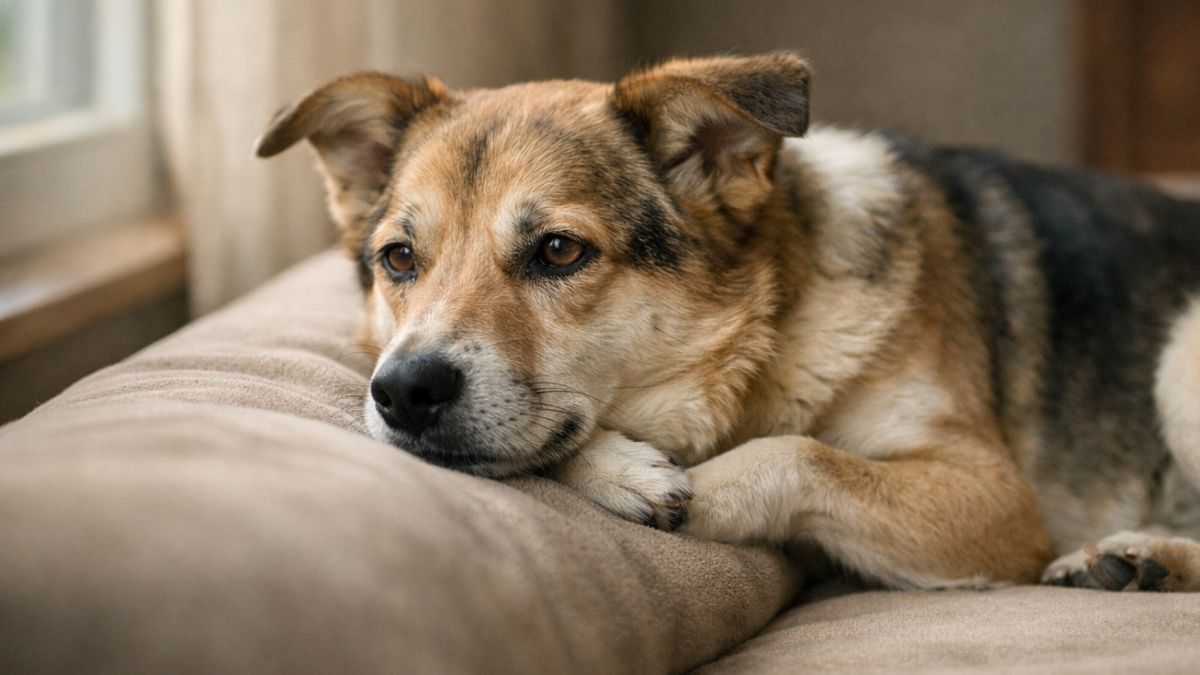
Subtle emotional withdrawal is one possible sign of past trauma in dogs.
The Subtle Signs Most Owners Miss
Not all trauma shows up as obvious fear or aggression. Sometimes it’s quieter. Easier to miss. These are the signs that often get chalked up to “personality” when they’re actually coping mechanisms.
Avoidance of Certain Spaces
The dog consistently refuses to enter specific rooms, walk on certain floor types, or go through doorways—even with no visible threat present.
Excessive “People Pleasing”
Constant checking in for approval, inability to relax unless they’re sure you’re happy, immediate submission to any command or gesture (even ones not directed at them).
Resource Guarding
Intense protection of food, toys, or sleeping spots—often stemming from scarcity in their past. May guard you as well, having learned that security is temporary.
Difficulty With Touch
Flinching when reached for (especially from above or behind), resistance to being held or restrained, or only accepting touch on their terms in specific ways.
Startle Reflex on Steroids
Jumps dramatically at sounds that wouldn’t bother most dogs—and the recovery time is prolonged. May take 10-20 minutes to calm down after a minor startle.
Selective Deafness to Commands
Knows commands perfectly in calm settings but “forgets” them when stressed. This is trauma-related cognitive shutdown, not stubbornness.
Important: Any single one of these behaviors doesn’t automatically mean trauma. It’s the pattern—multiple signs occurring consistently over time, especially in the absence of recent negative experiences—that points to past trauma.
Reading the Body Language of Trauma
Traumatized dogs often communicate their distress through subtle body language that’s easy to miss if you’re not specifically watching for it.
What to Watch For:
Whale Eye
When you can see the whites of their eyes because they’re looking away while keeping their head toward the threat. This is stress and discomfort.
Lip Licking and Yawning (When Not Tired)
Stress signals. Traumatized dogs do this frequently, even in seemingly calm situations—because they’re never truly calm inside.
Low Body Posture
Constantly crouched, tail tucked, ears back—even in safe environments. They’re making themselves as small and non-threatening as possible.
Freezing Mid-Motion
Stops completely in the middle of an action—walking, eating, playing—when triggered. This is dissociation, a trauma response.
Panting Without Physical Exertion
Heavy breathing when they haven’t been active and the temperature is fine. This is anxiety panting—their body is in fight-or-flight mode.
What Trauma Is NOT
It’s important to distinguish trauma from other behavioral issues. Not every fearful dog is traumatized, and mislabeling can lead to inappropriate treatment approaches.
Normal Fear Responses
Being scared of thunder, fireworks, or the vet is normal. These are genuinely frightening experiences. Trauma is when the fear is disproportionate, generalized, or triggered by neutral stimuli.
Lack of Socialization
A dog who wasn’t exposed to various people, places, or experiences as a puppy may be fearful of new things—but that’s different from trauma. These dogs can often learn through gradual, positive exposure.
Breed-Specific Traits
Some breeds are naturally more cautious, reserved, or sensitive. This isn’t trauma—it’s genetics. However, sensitive dogs can be more prone to developing trauma if exposed to overwhelming situations.
Recent Singular Events
If your dog was scared by something yesterday and is still nervous today, that’s not necessarily trauma—it’s a normal adjustment period. Trauma develops from repeated experiences or single events so overwhelming the brain can’t process them.
The One Question That Reveals Everything
If you’re still unsure whether your dog’s behavior indicates trauma, ask yourself this:
“Is my dog’s fear response improving with time, patience, and positive experiences—or is it staying the same despite a safe, loving environment?”
Normal fears fade with repeated safe exposure. Trauma-based fears persist or even worsen because they’re not rational responses to current threats—they’re echoes of past overwhelming experiences.
If you’ve had your dog for six months, provided consistent kindness, removed triggers where possible, and the fear responses remain intense and unchanged—that’s a strong indicator of trauma.
What Actually Helps Traumatized Dogs
Recognizing trauma is only the first step. Here’s what actually makes a difference:
Predictability and Routine
Traumatized dogs need to know what’s coming next. Establish and maintain consistent routines for:
- →Feeding times (same time, same place, same bowl)
- →Walk schedules (same routes initially)
- →Sleep locations (let them choose and keep it consistent)
- →Daily activities (play time, quiet time, training time)
Predictability = safety in the traumatized dog’s brain.
Patience (Measured in Months, Not Weeks)
Trauma recovery is slow. Weeks will pass where you see no progress. Then suddenly, your dog will do something they couldn’t do before—enter a room, accept a touch, relax for ten minutes.
These micro-victories are massive. Celebrate them quietly. Don’t expect linear progress.
Want to go deeper?
Read more about animal health and well-being
Professional Help (The Right Kind)
Not all trainers understand trauma. You need someone who:
- →Uses force-free, positive reinforcement methods exclusively
- →Has experience with reactive or fearful dogs specifically
- →Understands that “pushing through” fear makes trauma worse
- →Works at the dog’s pace, not a predetermined timeline
Red flag: Anyone who tells you to “show dominance” or “make the dog face their fears” doesn’t understand trauma and will make things worse.
Safe Spaces (Non-Negotiable)
Create a place where the dog can retreat and be absolutely left alone. A crate with a blanket over it, a quiet corner behind furniture, a specific room—whatever they choose.
Rule: When the dog is in their safe space, no one—especially children—bothers them. Ever.
What NOT to Do
- ✗Force interaction (“Just pet the nice dog!” to strangers)
- ✗Punish fearful behavior (it’s not misbehavior, it’s terror)
- ✗Flood them with triggers (“exposure therapy” without proper guidance)
- ✗Expect gratitude or quick bonding (trust takes time)
- ✗Compare them to “normal” dogs (they’re doing their best)
A Gentle Reality Check
Some traumatized dogs make remarkable recoveries. They learn to trust again, to relax, to enjoy life in ways they couldn’t before.
But some never fully “get over it.” And that’s okay.
Your job isn’t to fix your dog or erase their past. Your job is to provide safety, patience, and acceptance while they navigate their new life with the psychological scars they carry.
Progress for a traumatized dog might look like:
- •They still won’t let strangers touch them, but they can be in the same room without panicking
- •They still resource guard food, but they’re eating calmly instead of frantically
- •They still avoid the kitchen, but they’ll stand at the doorway instead of three rooms away
These aren’t failures. These are victories.
Loving a traumatized dog means celebrating the small steps and accepting that some wounds may never fully heal—and that’s not a reflection on you or them.
Final Thoughts
If you’ve read this far and recognized your dog in these descriptions, I need you to know something:
You didn’t cause this. And you can’t undo it.
But you can provide something their traumatized mind desperately needs: a predictable, patient presence that doesn’t demand more than they can give.
The flinch when you reach for the broom might never go away completely. The hypervigilance might ease but not disappear. The fear of certain men in certain hats might be permanent.
And that’s not defeat.
That’s a dog learning that even with their wounds, they’re worthy of love. Because you keep showing up, keep being patient, keep being safe.
That lesson alone can change everything.
Common Questions About Dog Trauma
Can a dog recover from trauma completely?
Some dogs make remarkable recoveries and appear to move past their trauma entirely. Others improve significantly but retain certain triggers or sensitivities throughout their lives. Complete recovery depends on factors like the severity of trauma, age when it occurred, duration of traumatic experiences, and quality of rehabilitation. The goal should be improvement in quality of life rather than “perfection.”
How long does it take for a traumatized dog to trust?
There’s no fixed timeline. Some dogs show trust within weeks; others take years. The “3-3-3 rule” (3 days to decompress, 3 weeks to learn routine, 3 months to feel at home) is a general guideline, but traumatized dogs often need much longer. Focus on small signs of progress rather than waiting for a breakthrough moment that may never come in the way you expect.
Should I adopt a dog with trauma if I’ve never had a dog before?
This is an honest question that deserves an honest answer: it depends on your resources, patience, and willingness to get professional help. Traumatized dogs require consistency, understanding of canine body language, and often professional behavioral support. If you’re committed to learning, have time to dedicate, and can afford a qualified force-free trainer or behaviorist, it can work. But it’s significantly more challenging than adopting a well-adjusted dog, and you should go in with realistic expectations.
What’s the difference between a scared dog and a traumatized dog?
A scared dog shows appropriate fear responses to genuinely frightening stimuli and recovers once the threat is removed. A traumatized dog displays fear responses that are disproportionate to the current situation, triggered by reminders of past trauma rather than actual present danger, and persist even in safe environments. Scared dogs improve with positive experiences; traumatized dogs’ fears persist despite safety and kindness.
Can medication help a traumatized dog?
Yes, in many cases. Anti-anxiety medications prescribed by a veterinary behaviorist can help reduce the dog’s baseline anxiety enough that they can learn and respond to behavioral modification. Medication isn’t a cure and shouldn’t be the only intervention, but it can be a valuable tool that makes training possible for severely traumatized dogs who otherwise can’t calm down enough to learn. Always work with a vet who specializes in behavior, not just a general practitioner.
About DogCityGuide
We write about dogs the way they actually are—complex, individual, sometimes difficult, always worthy of understanding. No sugar-coating, no toxic positivity, just honest guidance for people who love dogs enough to do the hard work.