You just brought home your puppy. They’re adorable. They follow you everywhere. They cry if you even go to the bathroom.
And you’re thinking: “How am I ever going to leave this puppy alone?”
Here’s the reality: You WILL need to leave your puppy alone eventually. For work. For errands. For your sanity.
But if you do it wrong—leaving them too long, too soon, without preparation—you risk creating separation anxiety that lasts for years.
The good news? With the right training protocol, you can teach your puppy that being alone is boring, safe, and totally fine.
In this guide, I’m giving you the exact step-by-step training schedule used by professional dog trainers, backed by research, to prepare your puppy for alone time—without trauma, without anxiety, without destroying your house.
Let’s do this right. 🐾
🎯 Quick Answer (TL;DR)
How do you leave a puppy alone for the first time? Use gradual desensitization: start with 5-10 minute absences and slowly build up over weeks. Research shows systematic desensitization combined with counterconditioning (positive associations) is the most evidence-based approach to prevent separation anxiety. Never leave puppies alone longer than they can hold their bladder (1 hour per month of age + 1, max 4 hours for young puppies). The Generation Pup study (2024) found 47% of puppies develop separation issues by 6 months without proper training.
Bottom line: Start training from DAY ONE. Build up gradually. Make alone time boring and predictable. By 4-6 months, your puppy should comfortably handle 2-4 hours alone.
Table of Contents
- Why Early Training Matters (The Research)
- How Long Can You Leave a Puppy Alone by Age?
- The Training Protocol: Gradual Desensitization
- Week-by-Week Training Schedule
- Before the First Time: Setup Checklist
- Step-by-Step: Your Puppy’s First Time Alone
- Common Mistakes That Create Separation Anxiety
- What to Do If Your Puppy Cries
- Signs Your Puppy Is Ready for Longer Alone Time
- Troubleshooting: When Training Isn’t Working
- FAQ: Puppy Alone Time Training
Why Early Training Matters (The Research)
Let’s start with why this is so important.
The Statistics Are Sobering
Research from the Generation Pup longitudinal study (2024) found:
“Nearly half of puppies (46.9%) develop separation-related behaviors by 6 months without proper training.”
Translation: If you don’t train your puppy to be alone, there’s a 47% chance they’ll develop anxiety issues.
And once separation anxiety sets in? Studies show it’s much harder to fix than prevent.
The Good News: Training Works
The same research found:
“Treatment with systematic desensitization produced significant reductions in both the frequency and severity of separation-related behaviours, with six dogs showing almost complete elimination of the problem behaviour three months after treatment ended.”
What this means: The gradual training protocol we’re about to teach you actually works. It’s not just theory—it’s proven.
Sleep Matters Too
Interestingly, the 2024 Generation Pup study also found:
“Puppies getting 9 or more hours of sleep per night show significantly lower rates of separation-related behaviors.”
Key takeaway: Well-rested puppies = less anxious puppies. Make sure your pup is getting enough sleep.
How Long Can You Leave a Puppy Alone by Age?
Before we train, let’s establish realistic expectations.
The Rule of Thumb
Puppies can hold their bladder for approximately:
- 1 hour per month of age + 1 hour
Examples:
- 8 weeks old (2 months): 2-3 hours MAX
- 12 weeks old (3 months): 3-4 hours MAX
- 16 weeks old (4 months): 4-5 hours MAX
- 24 weeks old (6 months): 6-7 hours MAX
Recommended Maximum Alone Time (Conservative)
| Puppy Age | Maximum Alone Time | Ideal Training Target |
|---|---|---|
| 8-10 weeks | 30-60 min | Start with 5-10 min, build to 30-45 min |
| 10-12 weeks | 1-2 hours | Gradually build to 1.5 hours comfortably |
| 3-4 months | 2-4 hours | Work toward 3 hours solid |
| 4-6 months | 4-6 hours | Build to 4-5 hours for short work days |
| 6-12 months | 6-8 hours | Approaching adult capacity |
Important: These are MAXIMUMS. Just because your puppy can physically hold their bladder doesn’t mean they should be alone that long every single day.
The Training Protocol: Gradual Desensitization
This is the scientifically-proven method to prevent separation anxiety.
What Is Gradual Desensitization?
“Desensitization involves teaching your dog to tolerate being alone for increasingly longer periods, starting with time frames so short that your dog barely notices you’re gone, working below their ‘anxiety threshold.’”
In simple terms:
- Start with absences so short they don’t stress your puppy (5 minutes)
- Gradually increase duration (5 → 10 → 15 → 30 min, etc.)
- Never push too fast (stay below anxiety threshold)
- Pair with positive experiences (treats, toys)
Why It Works
“This incremental approach is not only the most effective way to change separation-related behavior, it is also the most efficient in the long term.”
Translation: Going slow now = faster success later. Rushing = months or years of anxiety.
Week-by-Week Training Schedule
Here’s your exact roadmap.
Week 1 (Age 8-9 weeks): Foundation
Goal: Puppy learns being alone is boring and safe.
Daily practice (3-5 sessions per day):
- Leave puppy in safe space (crate or pen)
- Walk to another room
- Stay gone for 5 minutes
- Return calmly (no big greeting)
- Let puppy out after they’re calm
Duration progression:
- Day 1-2: 5 minutes
- Day 3-4: 7 minutes
- Day 5-7: 10 minutes
Tips:
- Practice when puppy is tired (post-play, post-meal)
- Leave a stuffed Kong or chew toy
- Ignore whining (don’t return until quiet)
Week 2 (Age 9-10 weeks): Building Confidence
Goal: Extend to 15-20 minutes comfortably.
Daily practice (3-4 sessions per day):
- Start at 10 minutes
- Increase by 2-3 minutes each session
Duration progression:
- Day 8-10: 10-12 minutes
- Day 11-14: 15-20 minutes
Add complexity:
- Leave the house (step outside, come back in)
- Jingle keys, put on shoes (desensitize to departure cues)
- Vary departure timing (don’t be predictable)
Week 3 (Age 10-11 weeks): Short Errands
Goal: Puppy handles 30-45 minutes.
Daily practice (2-3 real departures):
- Actually leave house
- Run quick errand (check mail, drive around block)
- Return before puppy reaches anxiety
Duration progression:
- Day 15-17: 20-30 minutes
- Day 18-21: 30-45 minutes
What to monitor:
- Use pet camera if possible
- Check for signs of distress (excessive barking, destructive behavior)
- If puppy is frantic, you’ve gone too fast—scale back
Week 4-6 (Age 11-14 weeks): Building to 1-2 Hours
Goal: Puppy comfortably alone for 1.5-2 hours.
Daily practice:
- 1-2 real departures per day
- Gradually extend to 60 min, then 90 min, then 2 hours
Duration progression:
- Week 4: 45-60 minutes
- Week 5: 60-90 minutes
- Week 6: 90-120 minutes
Key strategies:
- Morning potty + play session before leaving (tire puppy out)
- Frozen Kong to keep busy first 20-30 min
- Calm departures (no dramatic goodbyes)
- Calm arrivals (wait for puppy to settle before attention)
Week 7-12 (Age 14-20 weeks): Approaching Work Hours
Goal: Build to 3-4 hours for short work days.
Daily practice:
- Real-life scenarios (go to work for half-day, run errands)
- Continue gradual increases
Duration progression:
- Week 7-8: 2-3 hours
- Week 9-10: 3-4 hours
- Week 11-12: 4 hours solid
Reality check:
- By 4 months old, most puppies can handle 3-4 hours
- If you work full-time (8 hours), you STILL need midday care until 6+ months
- Don’t rush this—separation anxiety takes months to fix, but weeks to prevent
Before the First Time: Setup Checklist
Preparation is everything.
✅ Safe Space Setup
Option 1: Crate
- Size: Puppy can stand, turn, lie down (not too big or they’ll pee in corner)
- Make cozy: Soft blanket, safe toy
- Location: Quiet area, not isolated (kitchen/living room)
Option 2: Puppy Pen/Playpen
- Larger space than crate
- Include: bed, water bowl, pee pad (if needed), toys
- Puppy-proofed (no hazards)
Why it matters: Research shows puppies restricted to crates or rooms overnight at 16 weeks or younger were less likely to develop separation anxiety.
✅ Supplies
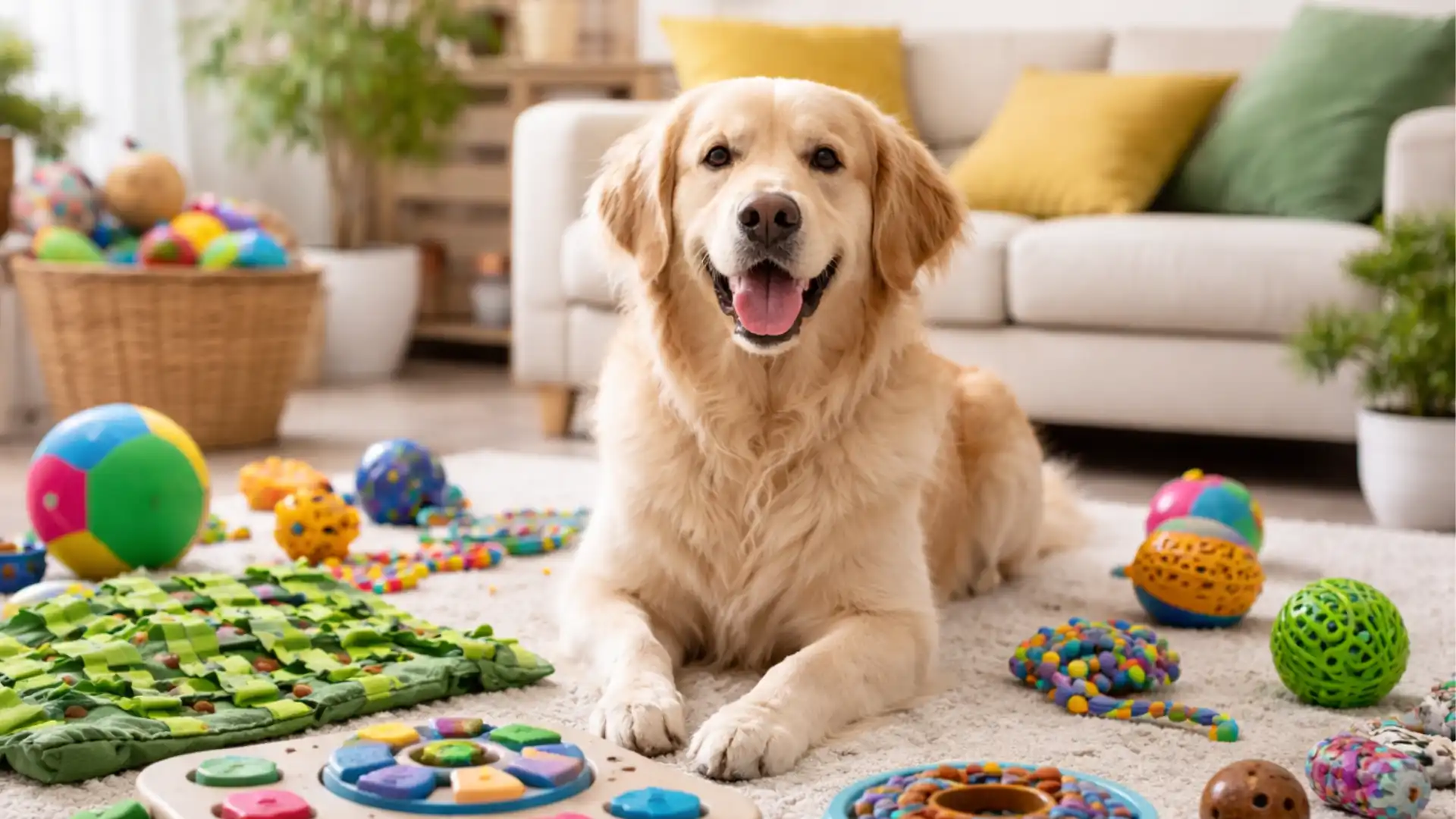
- Frozen Kong (keeps puppy busy 20-30 min)
- Safe chew toys (Nylabone, rope toy)
- Water bowl (heavy, won’t tip)
- Pee pads (if gone longer than puppy can hold bladder)
- Pet camera (to monitor without being seen)
✅ Pre-Departure Routine
Create a boring, predictable routine:
- Potty break
- 10-15 min play session (tire puppy out)
- Give frozen Kong or chew toy
- Calmly place puppy in crate/pen
- Leave without fanfare (no “Goodbye baby I’ll miss you!”)
The goal: Make leaving boring. No drama = no anxiety.
Step-by-Step: Your Puppy’s First Time Alone
Let’s walk through the very first session.
Step 1: Tire Your Puppy Out
- Play: 10-15 min active play (fetch, tug, chase)
- Potty: Take outside, make sure they pee/poop
- Goal: Puppy is ready for a nap
Step 2: Give High-Value Distraction
- Frozen Kong stuffed with peanut butter + kibble
- OR long-lasting chew (bully stick for older puppies)
- Give it TO them in their crate/pen (creates positive association)
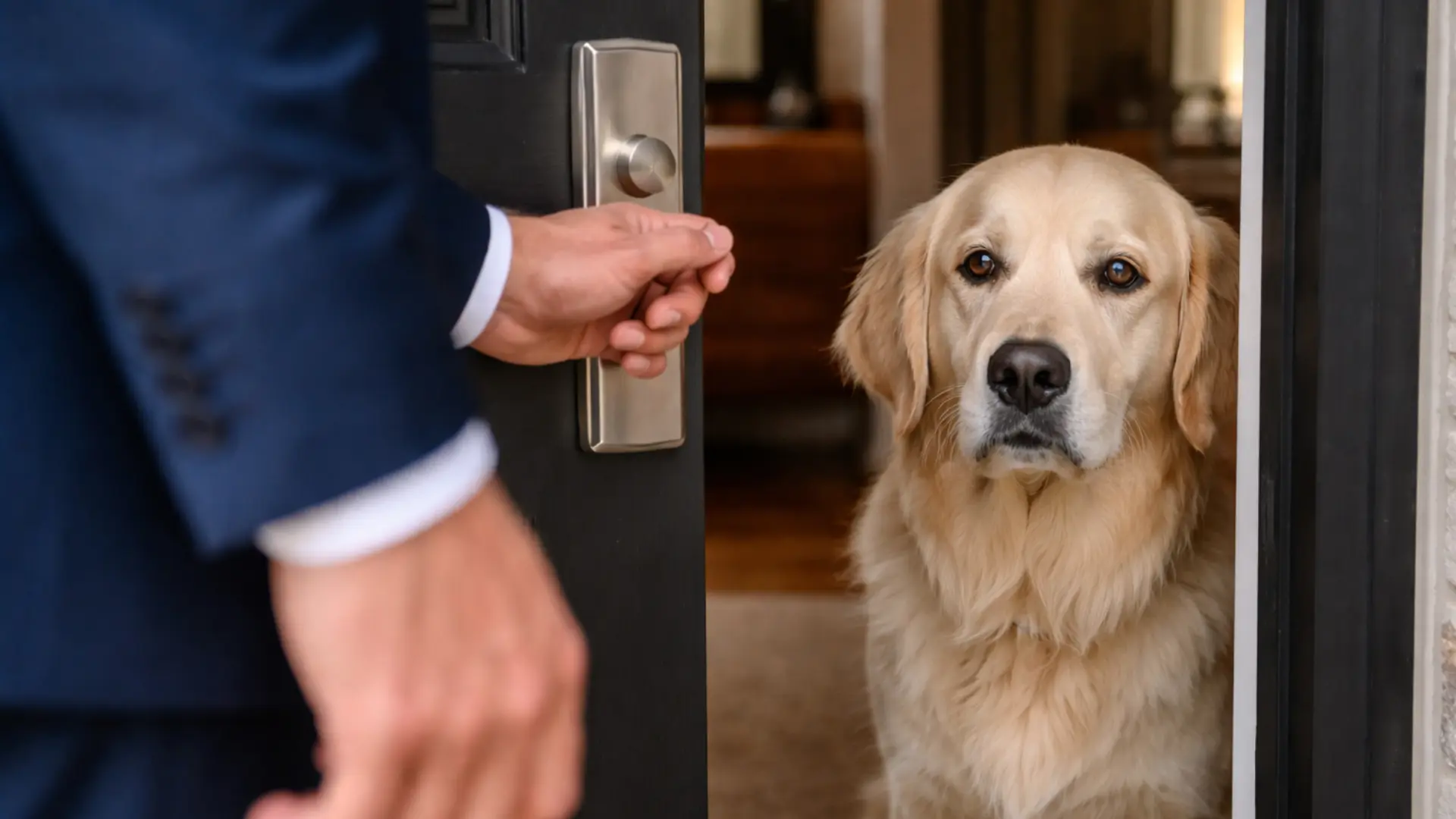
Step 3: Calmly Leave
- No talking, no eye contact, no “goodbye”
- Just place puppy in space, close door/gate, walk away
- Important: Act like this is the most boring thing ever
Step 4: Stay Gone 5-10 Minutes
- Set a timer
- Don’t peek
- If puppy cries, ignore (as long as it’s not panic)
Step 5: Return Calmly
- Don’t rush to puppy immediately
- Wait until they’re calm/quiet
- Then calmly open crate, let them out
- Low-key greeting (no “OH I MISSED YOU SO MUCH!!!”)
Why calm returns matter: If you make a big deal when you return, puppy learns “being apart is a BIG EMOTIONAL EVENT.” You want them to learn “being apart is boring and normal.”
Common Mistakes That Create Separation Anxiety
Avoid these at all costs:
❌ Mistake #1: Waiting Too Long to Start Training
The mistake: “I’ll wait until they’re older to leave them alone.”
Why it backfires: Puppies learn fastest at 8-16 weeks. Waiting means they form bad habits (expectation of constant companionship).
Fix: Start from day one with short (5 min) absences.
❌ Mistake #2: Going 0 to 60 Too Fast
The mistake: “My puppy was fine alone for 10 minutes, so I left for 2 hours.”
Why it backfires: You exceeded their anxiety threshold. One bad experience can undo weeks of training.
Fix: Increase gradually. 5% longer each session is a safe rule.
❌ Mistake #3: Dramatic Departures & Arrivals
The mistake: “Goodbye sweetie! Mommy will miss you SO MUCH! Be a good baby!”
Why it backfires: You’re telling your puppy “this is a BIG SCARY THING.”
Fix: Treat departures and arrivals like nothing. Boring = safe.
❌ Mistake #4: Returning When Puppy Is Crying
The mistake: “My puppy was crying so I came back to comfort them.”
Why it backfires: You just taught puppy “if I cry, they return.” This REINFORCES crying.
Fix: Only return when puppy is calm/quiet. Ignore whining.
Exception: If puppy is in genuine distress (frantic, panicked), you went too fast—scale back duration next time.
❌ Mistake #5: Leaving Too Long for Bladder Capacity
The mistake: “I left my 10-week-old puppy alone for 4 hours.”
Why it backfires: Puppy was forced to pee in crate (breaks house-training) and was uncomfortable.
Fix: Never exceed bladder capacity (1 hour per month of age + 1).
What to Do If Your Puppy Cries
This is the #1 question.
Normal Whining vs. Distress
Normal whining (ignore it):
- Puppy whines for 2-5 minutes, then settles
- Soft, intermittent whining
- Exploring crate, chewing toy, eventually lying down
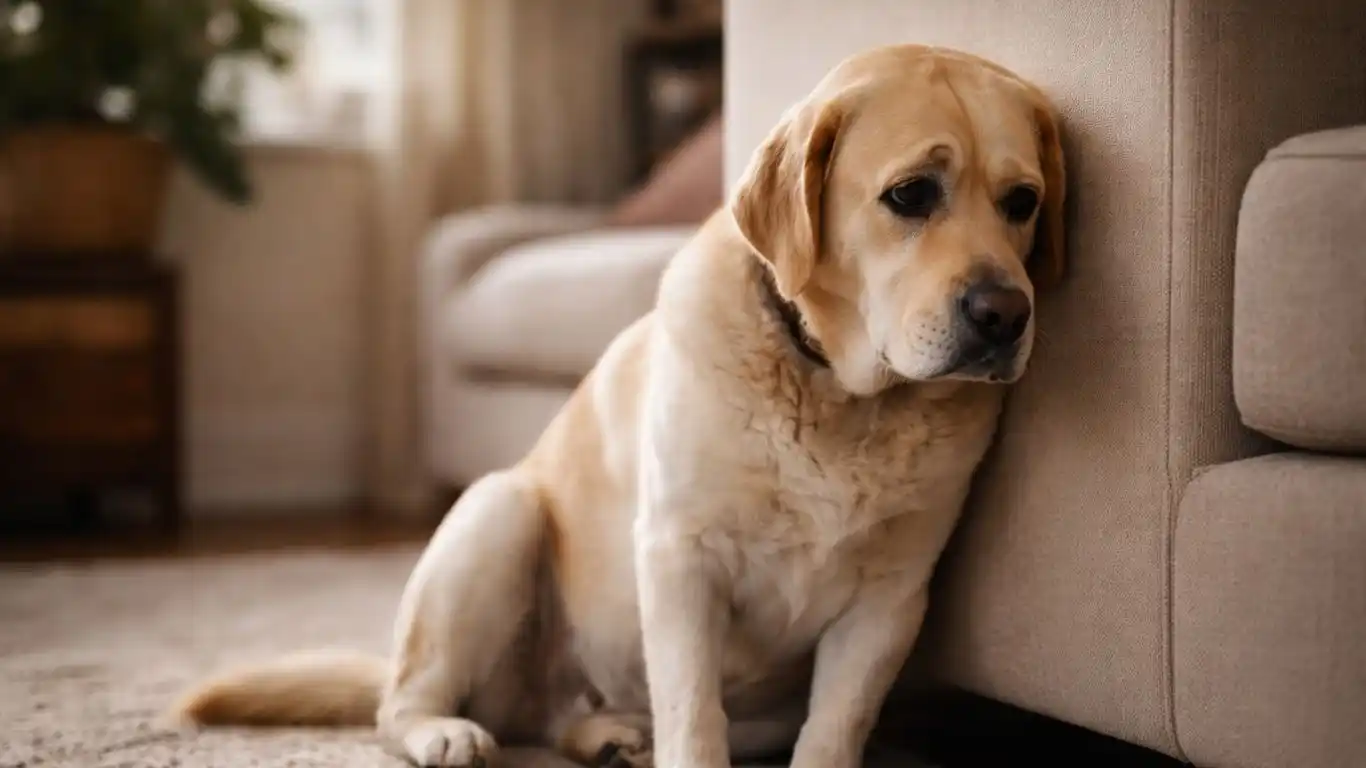
Distress (intervention needed):
- Frantic, escalating crying for 10+ minutes
- Trying to escape (scratching, biting crate)
- Panting, drooling, trembling
- Urinating/defecating from panic
When to Ignore, When to Intervene
Ignore if:
- Puppy is just complaining (not panicking)
- Whining is decreasing over time
- Puppy settles within 5-10 min
Intervene if:
- Puppy is in genuine panic (signs above)
- Crying escalates after 10+ minutes
- Puppy is harming themselves
How to Intervene Without Reinforcing Crying
If you MUST go back:
- Wait for even 2 seconds of quiet
- Return calmly
- Don’t let puppy out immediately
- Wait until calm, THEN let out
- Next session: reduce duration (you went too fast)
Key: Never reward crying by letting them out WHILE crying.
Signs Your Puppy Is Ready for Longer Alone Time
How do you know when to increase duration?
✅ Green Lights (Increase Duration)
- Puppy settles within 5 min of you leaving
- No excessive barking/whining
- Sleeps or chews toy calmly
- Greets you calmly when you return (not frantic)
- No house accidents
- No destructive behavior
If you see all these, you can increase by 10-20% next session.
⚠️ Yellow Lights (Hold Duration, Don’t Increase Yet)
- Puppy takes 5-10 min to settle
- Some whining but stops on own
- Greeting is a bit excited but calms within 2 min
Stay at this duration for a few more sessions before increasing.
🚫 Red Lights (Decrease Duration)
- Puppy cries entire time
- Destructive behavior (chewing crate, escaping attempts)
- House accidents (anxiety-induced)
- Frantic greeting (can’t calm down)
You’ve exceeded their threshold. Drop back to last comfortable duration.
Troubleshooting: When Training Isn’t Working
What if your puppy just won’t settle?
Problem: Puppy Cries Every Single Time
Possible causes:
- Duration too long too fast
- Not tired enough before alone time
- Medical issue (pain, need to potty)
- Genuine separation anxiety
Solutions:
- Drop back to 2-3 minute absences
- Increase pre-departure exercise
- Rule out medical issues (vet check)
- Consider consulting certified dog trainer
Problem: Puppy Was Fine, Now Regressing
Possible causes:
- Developmental fear period (normal at 8-10 weeks, 6-14 months)
- Recent stressful event
- Inconsistent practice
Solutions:
- Reduce duration temporarily
- Maintain consistency
- Extra positive associations (better treats)
- Wait out fear period (usually 1-2 weeks)
Problem: Puppy Pees in Crate Every Time
Possible causes:
- Crate too big (can pee in corner, sleep in other side)
- Left alone longer than bladder capacity
- Not fully house-trained yet
- Medical issue (UTI)
Solutions:
- Use crate divider to make space smaller
- Shorten alone time
- More frequent potty breaks
- Vet check for UTI
FAQ: Puppy Alone Time Training
How long can I leave my 8-week-old puppy alone?
Maximum 1-2 hours, but start training with 5-10 minute absences. Eight-week-old puppies have tiny bladders (can hold for 2-3 hours max) and are in critical socialization period. If you work full-time, you need midday care (sitter, neighbor, or puppy daycare).
When should I start training my puppy to be alone?
Day one. Research shows puppies who don’t learn to be alone early have a 47% chance of developing separation anxiety by 6 months. Start with 5-minute absences from the first week you bring them home.
Should I leave my puppy in a crate or pen?
Both work. Crates are better for house-training (dogs won’t pee where they sleep) and create a den-like space. Pens give more room but may include pee pads. Research suggests puppies restricted to crates at 16 weeks or younger actually show lower separation anxiety rates.
My puppy cries when I leave. Am I traumatizing them?
No, as long as crying is normal whining (not panic) and puppy settles within 5-10 minutes. Learning to be alone involves some frustration—that’s normal. What traumatizes puppies is being left too long (exceeding bladder capacity) or exceeding their anxiety threshold (going from 10 min to 4 hours with no gradual buildup).
How long does it take to train a puppy to be alone?
Most puppies can comfortably handle 2-3 hours alone by 4 months old if training started early and progressed gradually. By 6 months, many can handle 4-6 hours. Full adult capacity (8 hours) typically isn’t reached until 10-12 months. The process takes 8-16 weeks of consistent practice.
Can I leave my puppy alone while I work?
Depends on your puppy’s age and work hours. If working 8 hours, puppies under 6 months NEED midday care (walker, sitter, daycare). By 6-8 months, some puppies can handle a full workday, but 10-12 months is safer. Don’t rush this—separation anxiety takes months to fix but weeks to prevent.
What if I already created separation anxiety by leaving too long?
It’s not too late. Use the same gradual desensitization protocol but start from scratch with very short (1-2 minute) absences. Research shows systematic desensitization can significantly reduce or eliminate separation anxiety, even after it’s developed. Consider working with a certified dog trainer or veterinary behaviorist for severe cases.
Should I get two puppies so they’re not alone?
No. “Littermate syndrome” is real—two puppies raised together can become overly dependent on each other, struggle with training, and actually develop worse separation anxiety when apart. Train one puppy first, then consider a second dog later (if desired) once the first is well-adjusted.
The Bottom Line: Start Early, Go Slow, Stay Consistent
Here’s the truth about leaving puppies alone:
It’s one of the most important things you’ll teach them. More important than “sit” or “stay.” Because separation anxiety is one of the most heartbreaking, difficult-to-fix behavior problems in dogs.
But you have the power to prevent it entirely—by starting from day one, going slow, and staying consistent.
Five minutes today. Ten minutes next week. Thirty minutes next month. By the time your puppy is 6 months old, they’ll be a confident, independent little dog who knows you always come back.
That’s not just training. That’s giving your puppy the gift of emotional security for life. 🐾
Related Articles:
- Can I Leave My Dog Alone for 8 Hours? Working Owner’s Guide
- Can I Leave My Dog Alone Overnight?
- Dog Separation Anxiety: Signs & Solutions
Sources & Research
This article references peer-reviewed research and expert sources:
- PMC: Canine Separation Anxiety Treatment Strategies - Systematic desensitization effectiveness, Generation Pup study findings
- ScienceDirect: Efficacy of Systematic Desensitization - Evidence-based treatment protocols
- Separation Buddy: Puppy Training Schedule - Crate training and separation anxiety prevention
Written by Alex | January 4, 2026 | DogCityGuide.com