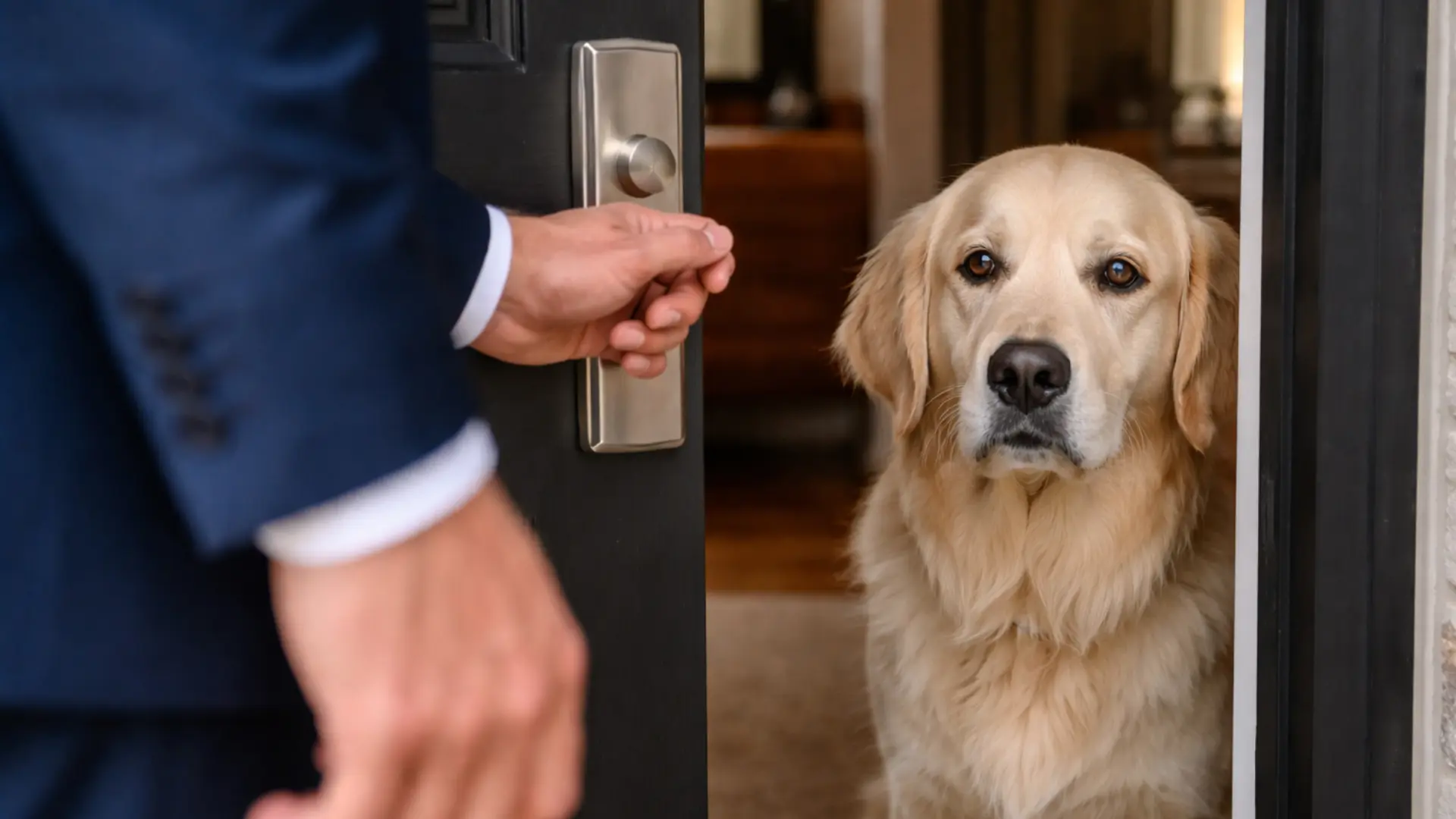
You come home to find your couch shredded. Again.
The neighbors texted—your dog barked for three hours straight while you were at work.
There’s drool everywhere. Your dog’s paws are bleeding from scratching at the door.
“Is this normal? Or does my dog have anxiety?”
Here’s what most vets won’t tell you upfront: Normal “I miss you” behavior and clinical separation anxiety are completely different things. One is annoying. The other is a medical condition causing genuine psychological distress.
And if you’re Googling “how to tell if my dog has separation anxiety,” you’ve probably already crossed that line.
The problem? Every article says “watch for these signs” but never tells you how severe is severe enough to need help. Is barking for 10 minutes a problem? What about an hour? When does destruction cross from “bad dog” to “anxious dog”?
According to 2025 veterinary behavior research, 20-40% of dogs suffer from some level of separation anxiety, but most owners don’t realize it until behaviors escalate to injury or eviction threats.
I’ve created the Dog Separation Anxiety Score Calculator—a 2-minute assessment that gives you a clinical score (0-100) based on your dog’s specific symptoms. No vague “maybe they have anxiety” BS. You’ll get:
✅ Your dog’s anxiety score (0-100) ✅ Severity level (Normal to Critical) ✅ Category breakdown (destructive behavior, vocalization, physical symptoms, duration, context) ✅ Personalized action plan ✅ When to see a vet/behaviorist (exact threshold)
Let’s find out if your dog is bored, bratty, or genuinely anxious—and what to do about it.
🎯 Quick Answer (TL;DR)
How do I know if my dog has separation anxiety? Take the 2-minute assessment below. You’ll get a score 0-100 across 5 categories: destructive behavior, vocalization, physical symptoms, duration/intensity, and context. Scores under 20 = normal attachment. 21-40 = mild concern. 41-60 = moderate anxiety (needs intervention). 61-80 = severe (vet consult). 81-100 = critical (urgent professional help). The calculator gives you a personalized action plan based on your dog’s specific symptoms.
Bottom line: If your dog’s behavior when alone is escalating, causing property damage, or resulting in self-injury, that’s not “bad behavior.” It’s panic. Scroll down to take the test now.
Table of Contents
- Take the Separation Anxiety Assessment
- What Is Separation Anxiety in Dogs?
- 20 Signs Your Dog Has Separation Anxiety
- The Science Behind Dog Separation Anxiety
- Understanding Your Dog’s Score
- Treatment Plans by Severity Level
- Common Mistakes That Make SA Worse
- When to See a Vet or Behaviorist
- FAQ: Dog Separation Anxiety
Take the Separation Anxiety Assessment
Ready to find out if your dog has clinical separation anxiety?
This interactive calculator evaluates 5 critical areas:
🏚️ Destructive Behavior — Property damage and escape attempts 📢 Excessive Vocalization — Barking, whining, howling when alone 😰 Physical Symptoms — Drooling, panting, house soiling, trembling ⏱️ Duration & Intensity — How long and how severe 🔍 Context & Triggers — When it happens and why
Instructions: Answer 15 questions honestly about what your dog does when you’re not home. Your results will show:
- Overall separation anxiety score (0-100)
- Severity level (Normal, Mild, Moderate, Severe, Critical)
- Category-by-category breakdown
- Personalized treatment recommendations
- Whether you need professional help (and how urgently)
What Is Separation Anxiety in Dogs?
Separation anxiety (SA) is a panic disorder triggered by being separated from their attachment figure—usually you.
It’s not:
- ❌ Being “spoiled” or “bratty”
- ❌ Lack of training
- ❌ Boredom
- ❌ “Teaching you a lesson” for leaving
It’s:
- ✅ A genuine panic response (like a human panic attack)
- ✅ Involuntary (your dog can’t control it)
- ✅ Medical anxiety disorder (requires treatment)
- ✅ Causes real psychological distress
The Difference: Boredom vs. Anxiety
Bored dog when you leave:
- Destroys random stuff (shoes, pillows, anything fun)
- Barks at sounds/people outside
- Calms down after 10-20 minutes
- Shows no physical stress signs
- Excited but not frantic when you return
Anxious dog when you leave:
- Destroys exit points (doors, windows) trying to get to YOU
- Barks constantly, sounds distressed
- Symptoms start immediately and continue for hours
- Physical stress: drooling, panting, trembling, accidents despite being house-trained
- Frantic, inconsolable when you return (takes 15+ minutes to calm down)
See the difference? Boredom is “I have nothing to do.” Anxiety is “I’m in danger without you.”
How Common Is Separation Anxiety?
Research shows:
- 20-40% of dogs experience some level of SA
- 14% have severe, clinical SA requiring professional intervention
- 50%+ of shelter surrenders cite “behavioral problems” (many are undiagnosed SA)
- Rescue dogs have 2-3x higher SA rates than dogs raised from puppyhood
It’s incredibly common. You’re not alone. And it’s NOT your fault.
20 Signs Your Dog Has Separation Anxiety
Destructive Behavior
1. Exit-Point Destruction Your dog tears up doors, windows, doorframes, window sills—anywhere you left through. This isn’t random destruction. They’re trying to get to you.
2. Escape Attempts Breaks through windows, jumps fences, digs under doors. Dogs have injured themselves seriously (broken teeth, bloody paws) trying to escape when panicked.
3. Your Belongings Targeted Destroys YOUR clothes, YOUR shoes, YOUR side of the bed. They seek items that smell like you for comfort—then destroy them in distress.
4. Crate Panic If crated, they injure themselves trying to get out: broken teeth, bloody paws, damaged nails. NEVER crate an SA dog who isn’t already crate-comfortable—it worsens panic.
Vocalization
5. Constant Barking/Howling Not alert barking. Distress barking. Sounds panicked. Continues for 30 minutes to several hours.
6. High-Pitched Whining That desperate, distressed whine. Not the “I want a treat” whine. The “I’m scared” whine.
7. Immediate Onset Vocalization starts the moment you leave (or within 5 minutes) and continues. Boredom barking starts later and is sporadic.
8. Neighbors Complain If neighbors can hear it, it’s severe. Dogs can bark at conversation volume for hours when anxious.
Physical Symptoms
9. Excessive Drooling Puddles of drool. Stress activates salivation. You’ll come home to wet spots where they were pacing.
10. Panting/Hyperventilation Even when not hot. Stress panting. Sometimes escalates to hyperventilation (dangerous).
11. House Soiling Despite Being Trained Your dog is house-trained but has accidents when alone. This is stress incontinence, not a training issue.
12. Pacing Camera footage shows your dog walking the same path over and over. Some dogs pace for hours.
13. Trembling/Shaking Visible tremors from anxiety. Same as a human trembling during a panic attack.
14. Dilated Pupils If you have a camera, you might notice their pupils are huge when you’re gone. Adrenaline response.
Timing & Context
15. Immediate Reaction Symptoms start the second you leave. No delay. This indicates panic, not boredom.
16. Pre-Departure Anxiety Your dog shows stress BEFORE you leave: pacing, whining, following you room to room when you grab keys/put on shoes.
17. Hyper-Attachment Can’t be in a different room from you. If you close a bathroom door, they panic. This is “velcro dog” taken to extreme.
18. Frantic Greeting When you return, they’re frantic. Not just happy—frantic. Jumping, whining, can’t calm down for 15-30 minutes.
Other Signs
19. Refuses to Eat When Alone You leave food/treats, they don’t touch them. Anxiety suppresses appetite.
20. Follows You Everywhere Can’t relax unless you’re in sight. This is hyper-attachment, a core SA feature.
If your dog shows 5+ of these signs, take the assessment above. You’re likely dealing with clinical separation anxiety.
The Science Behind Dog Separation Anxiety
What’s Happening in Your Dog’s Brain
When you leave, your dog’s brain enters fight-or-flight mode:
Neurologically:
- Amygdala activates (fear center)
- Cortisol spikes (stress hormone)
- Adrenaline floods the system
- Prefrontal cortex shuts down (can’t think rationally)
Translation: Your dog is having a panic attack. They’re not thinking, “I’ll destroy the couch to teach them a lesson.” They’re thinking, “I’M IN DANGER. I HAVE TO GET OUT. WHERE ARE THEY?”
The Cortisol Problem
Cortisol (stress hormone) stays elevated for HOURS after a panic episode. Even if your dog calms down after 30 minutes, their body is still in stress mode for 3-6 hours.
This means:
- Daily separation = chronic stress
- Chronic stress = health problems (weakened immune system, GI issues, skin problems)
- Your dog is suffering even when they “seem fine” by the time you get home
Why Punishment Makes It Worse
Scenario: You come home to destruction. You yell at your dog.
What you think: “They’ll learn not to do this.”
What actually happens: Your dog’s already-stressed brain adds a new fear: “When they come home, bad things happen.” Now they’re anxious when you’re gone AND when you return.
Result: Anxiety worsens. Destruction escalates.
The science is clear: Punishment for SA-related behaviors makes the anxiety worse 100% of the time.
Genetics & Predisposition
Some dogs are genetically prone to anxiety:
- Herding breeds (Border Collies, Australian Shepherds) = hyper-bonding
- Toy breeds (Chihuahuas, Maltese) = bred for companionship
- Rescue dogs = trauma/abandonment history
- Dogs with general anxiety = higher SA risk
You didn’t cause this. But you can treat it.
Understanding Your Dog’s Score
After taking the assessment, you received a score from 0-100. Here’s what each range means:
0-20: Normal Attachment ✅
What it means: Your dog doesn’t have clinical separation anxiety. They might be a little sad when you leave or excited when you return, but it’s within normal range.
What to do:
- Keep doing what you’re doing
- Don’t make departures/arrivals a huge production
- Provide enrichment when alone (puzzle toys, chews)
- Ensure adequate exercise and mental stimulation
When to reassess: If behaviors worsen or new symptoms appear.
21-40: Mild Concern 🤔
What it means: Your dog shows early signs of separation anxiety or generalized anxiety. This is the intervention sweet spot—catch it now before it escalates.
What’s happening:
- Some distress when you leave, but manageable
- Might whine for 5-10 minutes then settle
- Occasional minor destruction (not daily)
- Slight pre-departure anxiety
What to do:
- Independence training: Practice being in different rooms. Close doors for 30 seconds, then 1 minute, then 5 minutes. Reward calm behavior.
- Desensitize departure cues: Pick up keys and sit back down. Put on shoes and don’t leave. Repeat 20x until your dog stops reacting.
- Create positive alone associations: Give special treat/toy ONLY when you leave. Remove when you return.
- Don’t make departures dramatic: No long goodbyes. Just leave calmly.
When to escalate: If symptoms worsen over 4 weeks or score moves to Moderate range.
41-60: Moderate Separation Anxiety ⚠️
What it means: Your dog has clinical separation anxiety that won’t resolve on its own. Without intervention, this typically worsens over time.
What’s happening:
- Regular destruction (multiple times per week)
- Barking/whining for 30+ minutes
- Some physical symptoms (drooling, panting)
- Pre-departure anxiety noticeable
- Takes 10-15 minutes to calm after you return
What to do:
- Hire a certified trainer: Look for CSAT (Certified Separation Anxiety Trainer) credentials. Regular trainers often don’t have SA expertise.
- Start systematic desensitization: This means gradually increasing alone time, starting at your dog’s current tolerance (even if that’s 30 seconds).
- Consider vet consultation: Ask about whether anxiety supplements or medication would help during training.
- Management while training: Doggy daycare, pet sitter, work from home if possible. Don’t leave your dog alone beyond their tolerance during training.
Timeline: Moderate SA treatment takes 2-6 months with consistent training.
When to escalate: If self-injury occurs, destruction intensifies, or your dog can’t be alone for even 5 minutes.
61-80: Severe Separation Anxiety 🚨
What it means: Your dog has severe separation anxiety causing significant distress. This requires professional help ASAP.
What’s happening:
- Intense destruction (major property damage)
- Constant vocalization for hours
- Multiple physical symptoms
- Can’t be alone for more than 15 minutes without panic
- May have injured themselves trying to escape
What to do (THIS WEEK):
-
Schedule vet appointment: Specifically mention “severe separation anxiety.” Ask about:
- Referral to veterinary behaviorist
- Prescription anxiety medication (fluoxetine, trazodone, clonazepam)
- Medical exam (rule out pain/illness contributing to anxiety)
-
Find a CSAT trainer: Severe SA needs specialist help. General trainers aren’t equipped for this.
-
Immediate management:
- DO NOT leave your dog alone if possible
- Doggy daycare daily
- Pet sitter/friend stays with dog
- Work from home temporarily
-
Medication is likely necessary: At this severity, your dog’s panic is too intense for training to work without pharmaceutical help to reduce the baseline anxiety first.
Timeline: Severe SA treatment takes 4-12 months. Medication + behavior modification together.
Red flags: Self-injury, complete inability to be alone (not even in another room), aggression when you try to leave.
81-100: Critical Separation Anxiety ⚠️🚨
What it means: URGENT. Your dog is in severe psychological distress. This is a medical emergency.
What’s happening:
- Extreme destruction with self-injury risk
- Constant, frantic vocalization
- Can’t be alone AT ALL—even in another room causes panic
- May have broken teeth, bloody paws from escape attempts
- Physical health declining (not eating, stress-related illness)
What to do (TODAY):
-
Call vet immediately: This is urgent. Explain severity. Most vets can fit in emergency behavior consultations.
-
Do NOT leave dog alone: Period. Even for 5 minutes. Get emergency help:
- Call in sick to work
- Emergency pet sitter
- Friend/family member stays with dog
- Bring dog to work if possible
-
Veterinary behaviorist referral: Your regular vet should refer you to a board-certified veterinary behaviorist (DACVB). These are vets with additional behavior specialization.
-
Medication is mandatory: At this level, medication isn’t optional. Your dog needs pharmaceutical intervention to reduce panic enough for behavior modification to even be possible.
-
Safety first: Remove anything your dog could injure themselves with. Block access to windows, cover sharp corners.
This is not “bad behavior.” This is a medical crisis. Treat it as seriously as if your dog had a broken leg.
Timeline: Critical SA treatment takes 6-18 months minimum. Requires medication, professional behavior modification, and complete management (never leaving dog alone until threshold improves).
Treatment Plans by Severity Level
For Mild SA (Score 21-40)
DIY Approach (With Vigilance):
Week 1-2: Baseline Assessment
- Record what triggers anxiety (grabbing keys? Putting on shoes?)
- Note current tolerance (how long can they be alone before distress starts?)
- Film your dog when you’re gone (10-minute absence)
Week 3-4: Desensitization to Departure Cues
- Practice “fake departures” 10x daily:
- Pick up keys, sit back down
- Put on coat, take it off
- Go to door, don’t leave
- Goal: Dog doesn’t react to these cues anymore
Week 5-8: Graduated Departures
- Start at 30 seconds: Leave, return immediately before anxiety starts
- If dog stays calm: increase to 1 minute
- Increase by 30 seconds only if previous duration shows zero anxiety
- This is SLOW. That’s correct. Rushing causes regression.
Week 9-12: Maintenance
- Continue gradual increases
- Practice randomly (not just when you actually leave)
- Reward calm behavior
Tools:
- Puzzle toys (Kong filled with frozen food)
- Calming music (studies show classical music reduces canine stress)
- Adaptil diffuser (dog-appeasing pheromone)
When to stop DIY and get help: If after 4 weeks you see no improvement or symptoms worsen.
For Moderate SA (Score 41-60)
Professional Help Required:
What to expect from a CSAT trainer:
Session 1: Assessment
- Review video of your dog alone
- Identify specific triggers and thresholds
- Create customized training plan
Weeks 1-4: Foundation
- You’ll practice departures at 10-30 second intervals
- May feel absurdly slow (“I can only leave for 2 minutes after a month?!”)
- This is normal. SA training is slow.
Weeks 5-12: Building Duration
- Gradually increase alone time
- Setbacks are common (one bad session = restart from earlier threshold)
- Consistency is everything
Weeks 13-24: Generalization
- Practice at different times of day
- Different departure routines
- Different locations
Medication consideration:
- Ask your vet about fluoxetine (Prozac) or clomipramine (both FDA-approved for canine SA)
- These reduce baseline anxiety, making training more effective
- Not a cure—must combine with behavior modification
Cost: CSAT training: $300-1,500 total (usually 6-12 sessions) Medication: $20-60/month
Success rate: 70-85% of moderate SA cases improve significantly with proper treatment.
For Severe/Critical SA (Score 61-100)
Veterinary Behaviorist Required:
Why not just a trainer? Severe SA often has comorbidities (general anxiety disorder, noise phobias, compulsive disorders). Veterinary behaviorists can prescribe medication and address complex cases.
What to expect:
Initial Consultation ($300-500):
- 90-minute evaluation
- Medical history review
- Video analysis
- Diagnosis + treatment plan
Medication Protocol:
-
Fast-acting (for immediate use):
- Trazodone or Alprazolam before anticipated separations
- Takes effect in 30-60 minutes
- Lasts 6-8 hours
-
Long-term (daily maintenance):
- Fluoxetine or Clomipramine
- Takes 4-6 weeks to reach full effect
- Reduces baseline anxiety
Behavior Modification (Concurrent):
- Can’t start until medication reduces panic enough for dog to learn
- Usually begins 4-6 weeks after starting medication
- Same desensitization protocol as moderate SA, but with professional oversight
Management:
- While medication takes effect, dog CANNOT be left alone
- Daycare, pet sitter, or you work from home
- This is non-negotiable—leaving them alone during this phase causes regression
Timeline:
- Weeks 1-6: Medication stabilization, zero alone time
- Weeks 7-12: Begin 30-second departures
- Months 4-6: Building to 30-60 minute absences
- Months 7-12: Approaching 2-4 hour absences
- Year 1+: Some dogs reach “normal” function, some maintain medication indefinitely
Cost:
- Initial consult: $300-500
- Follow-ups: $150-250 each (usually 4-6 needed)
- Medication: $30-80/month
- Total Year 1: $1,500-3,000
Success rate: 60-75% of severe SA cases improve to manageable levels. Some never fully resolve but become functional with medication.
Common Mistakes That Make SA Worse
Mistake #1: Punishing Destruction
What you do: Come home to a shredded couch. Yell at your dog. Rub their nose in it.
Why it backfires: Your dog destroyed the couch hours ago. They have NO IDEA why you’re angry now. Dogs live in the moment—they can’t connect punishment now to action earlier.
What actually happens: Your dog learns: “When my person comes home, bad things happen.” Now they’re anxious when you leave AND when you return.
Correct approach: Clean up silently. Don’t react. Focus on treating the anxiety, not punishing the symptom.
Mistake #2: Crating an Anxious Dog
What you do: “If I crate him, he can’t destroy stuff!”
Why it backfires: A crate is supposed to be a den—a safe space. For an anxious dog, it becomes a prison. Panic in a confined space = extreme distress. Dogs injure themselves trying to escape crates.
What actually happens:
- Broken teeth from biting bars
- Bloody paws from digging at crate floor
- Anxiety escalates to extreme levels
- You come home to a traumatized dog in a blood-splattered crate (yes, this happens)
Only crate if:
- Dog is already crate-comfortable (loves their crate)
- SA is mild and crate actually soothes them
- You’ve confirmed via camera that they’re calm in there
Otherwise: Don’t crate. Dog-proof a room instead.
Mistake #3: Getting Another Dog “For Company”
What you do: “If I get a second dog, they’ll keep each other company!”
Why it backfires: SA is separation from YOU, not loneliness. Your dog doesn’t want “a friend.” They want YOU.
What actually happens:
- First dog still has SA (now you have 2 anxious dogs)
- OR second dog learns SA behaviors from first dog
- OR dogs entertain each other for 10 minutes, then both panic
- Now you have 2x the destruction, 2x the barking
When it works: Basically never for SA. It works for boredom, not anxiety.
Mistake #4: “Flooding” (Forcing Them to Endure Panic)
What you do: “I’ll just leave for 8 hours and they’ll learn to deal with it.”
Why it backfires: This is called “flooding” in behavior terms. The theory is “exposure will desensitize them.” This is wrong for phobias and anxiety.
What actually happens:
- Your dog panics for 8 hours
- Cortisol stays elevated for hours after
- They learn: “Being alone is as terrifying as I thought”
- Anxiety worsens, behaviors escalate
- Some dogs shutdown (freeze response)—looks “better” but isn’t. They’re in learned helplessness.
Correct approach: Systematic desensitization starts BELOW threshold. If your dog can handle 2 minutes, you start at 30 seconds. Slow and steady.
Mistake #5: Ignoring Early Signs
What you do: “My dog barks for 10 minutes when I leave, but they stop eventually. It’s fine.”
Why it backfires: Early SA is the EASIEST to treat. Ignoring it lets it escalate.
What actually happens:
- 10 minutes becomes 30
- 30 becomes an hour
- Barking adds destruction
- Destruction adds escape attempts
- Now you have severe SA
Correct approach: Treat it when it’s mild. Prevention is 10x easier than cure.
When to See a Vet or Behaviorist
See Your Regular Vet If:
✅ Your dog’s separation anxiety score is 41+ ✅ Symptoms appeared suddenly (rule out medical causes) ✅ House soiling despite being trained (could be UTI, not anxiety) ✅ Excessive drooling (could be dental issue, not just stress) ✅ You want to try anti-anxiety medication
What your vet will do:
- Physical exam (rule out pain, illness)
- Blood work if needed
- Prescribe anti-anxiety medication if appropriate
- Refer to behaviorist if severe
See a Certified Trainer (CSAT) If:
✅ Separation anxiety score is 41-60 (moderate) ✅ You’ve tried DIY for 4 weeks with no improvement ✅ You need structured guidance for desensitization ✅ Symptoms are manageable but not resolving
Find a CSAT: MalenaDemartini.com maintains a directory of certified SA trainers.
See a Veterinary Behaviorist If:
✅ Separation anxiety score is 61+ (severe/critical) ✅ Self-injury has occurred ✅ Dog can’t be alone for even 5 minutes ✅ Multiple anxiety disorders (SA + noise phobia + general anxiety) ✅ Previous treatment attempts failed
Find a DACVB: ACVB.org maintains a directory of board-certified veterinary behaviorists.
Cost: Higher than trainers, but they can prescribe medication and handle complex cases.
FAQ: Dog Separation Anxiety
How do I know if my dog has separation anxiety or is just bored?
Short answer: Take the assessment above. Scores under 20 suggest boredom, not clinical SA.
Long answer: Bored dogs destroy random items (whatever’s fun), bark sporadically, and calm down within 15-20 minutes. Anxious dogs destroy exit points (trying to get to you), bark constantly with distress vocalizations, and show physical stress symptoms (drooling, panting, accidents). Bored dogs are annoying. Anxious dogs are suffering.
Test: Give your dog a frozen Kong when you leave. Bored dog will eat it. Anxious dog won’t touch it (anxiety suppresses appetite).
Can separation anxiety be cured?
Short answer: Yes, most cases can improve significantly with proper treatment. Some dogs become completely “cured,” some manage with ongoing maintenance.
Long answer: Mild-to-moderate SA has a 70-85% success rate with systematic desensitization training. Severe SA is more complex—60-75% improve to manageable levels, but some require lifelong medication. “Cure” depends on severity, how long the dog has had SA, and treatment consistency.
Timeline: Mild SA = 2-4 months. Moderate = 4-8 months. Severe = 6-18 months.
Should I get a second dog to keep my anxious dog company?
Short answer: No. This almost never works for separation anxiety.
Long answer: SA is separation from YOU, not loneliness. Your dog doesn’t want a companion dog—they want their attachment figure (you). Getting a second dog usually results in: 1) First dog still has SA, 2) Second dog learns SA from first dog, or 3) Both dogs are briefly distracted then both panic. You end up with 2x the destruction and 2x the vet bills.
Exception: If your dog is bored (not anxious), a second dog might help. But boredom ≠ anxiety.
What’s the best medication for dog separation anxiety?
Short answer: Fluoxetine (Prozac) and clomipramine are FDA-approved for canine SA and most commonly prescribed.
Long answer:
- Fluoxetine (Prozac): Daily SSRI. Takes 4-6 weeks to work. Reduces baseline anxiety long-term.
- Clomipramine (Clomicalm): Daily tricyclic antidepressant. Similar timeline and effect.
- Trazodone: Fast-acting (1 hour). Use for anticipated separations. Doesn’t treat underlying anxiety.
- Alprazolam (Xanax): Fast-acting. More sedating. Used for acute panic.
Your vet will choose based on:
- Your dog’s specific symptoms
- Other health conditions
- Medication interactions
- Severity of SA
Important: Medication alone doesn’t cure SA. Must combine with behavior modification.
How long does it take to train away separation anxiety?
Short answer: 2-18 months, depending on severity.
Long answer:
- Mild SA: 2-4 months of consistent training
- Moderate SA: 4-8 months with professional help
- Severe SA: 6-12 months minimum, sometimes 18+ months
Why so long? SA training is SLOW by design. You’re retraining your dog’s panic response. This means starting at 30-second absences and gradually building up. Rushing causes regression.
Realistic progression:
- Month 1: 30 seconds to 5 minutes
- Month 2: 5 minutes to 15 minutes
- Month 3: 15 minutes to 30 minutes
- Month 4: 30 minutes to 1 hour
- Month 5-6: 1 hour to 2 hours
- Month 7-12: Building to 4-8 hours
Setbacks are normal. One bad session can erase a week of progress.
Can I leave my dog with separation anxiety in a crate?
Short answer: Only if your dog ALREADY loves their crate. Otherwise, absolutely not.
Long answer: For an SA dog who isn’t crate-comfortable, a crate = prison. They panic in a confined space and injure themselves trying to escape (broken teeth, bloody paws). I’ve seen dogs break out of “indestructible” crates.
Safe to crate if:
- Dog voluntarily goes in crate to sleep
- Camera shows they’re calm in there when you leave (no pacing, whining, escape attempts)
- Door is left open sometimes and they still choose the crate
Never crate if:
- Dog resists going in
- Shows distress in crate
- Has ever injured themselves in a crate
Alternative: Dog-proof a room (remove hazards, provide enrichment). Give them space to move.
Will my dog grow out of separation anxiety?
Short answer: No. SA doesn’t resolve on its own—it typically worsens without intervention.
Long answer: Some puppies show SA-like behaviors (following you everywhere, whining when you leave) that ARE developmental and fade as they mature. But clinical SA in adult dogs doesn’t improve without treatment. Left untreated, behaviors escalate over time.
Puppy SA (under 1 year): May improve with maturity + independence training. Adult-onset SA: Requires active treatment. Won’t resolve on its own.
Red flag: If symptoms are worsening over months, that’s the trajectory without intervention.
What triggers separation anxiety in dogs?
Short answer: Major life changes, trauma, or genetic predisposition.
Long answer:
Common triggers:
- Shelter/rescue adoption: Trauma from abandonment or rehoming
- Owner hospitalization/death: Sudden absence of primary attachment figure
- Moving: New environment, loss of familiar territory
- Schedule change: You started working in office after being home
- Loss of another pet: Grief can trigger SA
- Traumatic event while alone: Storm, break-in, injury
Genetic factors:
- Herding breeds (Border Collies, Aussies) = hyper-bonding
- Toy breeds (bred for companionship)
- General anxiety = higher SA risk
- Some dogs are just wired for anxiety
Prevention: Gradual exposure to being alone starting in puppyhood. Practice independence training early.
Does getting an older dog prevent separation anxiety?
Short answer: No. Adult and senior dogs can develop SA just as easily as puppies.
Long answer: The myth is “older dogs are calmer, so they won’t get anxious.” Wrong. Adult-onset SA is common, especially in:
- Rescue dogs (trauma history)
- Dogs after major life changes (owner death, moving)
- Senior dogs with cognitive decline (dog dementia can trigger SA)
Age doesn’t protect against SA. Trauma, genetics, and life circumstances matter more.
The Bottom Line: Your Dog Isn’t “Bad”—They’re Scared
Here’s what I wish every dog owner understood:
Your dog isn’t destroying your house to punish you.
They’re not “being dramatic.”
They’re not “spoiled” or “needy.”
They’re having a panic attack every single time you walk out that door.
Imagine someone you love walks out and you genuinely believe they’re never coming back. Every. Single. Time.
That’s what separation anxiety feels like to your dog.
The good news: SA is treatable. Most dogs improve significantly with proper intervention. But you have to treat it as what it is—a medical anxiety disorder, not a behavior problem.
If you took the assessment and scored 41+, this is your sign to get help. Not next month. This week.
Your dog is counting on you to recognize that their “bad behavior” is actually a cry for help.
Related Articles:
- Dog Enrichment Score Calculator: Is Your Dog Bored?
- How to Show Your Dog You Love Them (+ Love Bond Quiz)
- Can I Leave My Dog Alone for 8 Hours?
- Dog Stress & Anxiety: Signs Your Dog Is Stressed
- Best Dog Trainers Near You: How to Find CSAT Certified
Sources & Research
This article references peer-reviewed research and veterinary behavior sources:
Scientific Studies:
- American Veterinary Medical Association (AVMA) - Canine Separation Anxiety Guidelines
- Journal of Veterinary Behavior (2025) - “Prevalence and Treatment of Canine Separation Anxiety”
- Veterinary Behaviorist Research (2024) - Cortisol levels in SA dogs
Expert Sources:
- Malena DeMartini, CTC - Certified Separation Anxiety Trainer, author of “Treating Separation Anxiety in Dogs”
- Dr. Karen Overall, VMD, PhD, DACVB - Veterinary Behaviorist
- American College of Veterinary Behaviorists (ACVB)
External Links:
- DACVB - Find a Veterinary Behaviorist
- Malena DeMartini - Find CSAT Trainer
- AVMA - Separation Anxiety Resources
Written by Alex | January 17, 2026 | DogCityGuide.com